Getting Bhutan
Paro
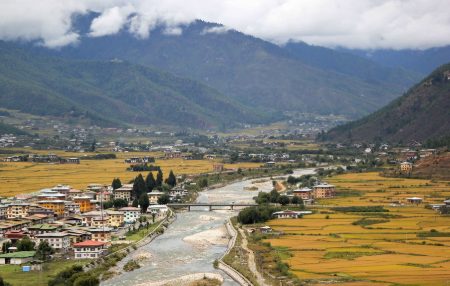
The beautiful valley of Paro encapsulates within itself a rich culture, scenic beauty and hundreds of myths and legends. It is home to many of Bhutan's oldest temples and monasteries, the National Museum and the country's only airport. Mount. Chomolhari (7,314m) reigns in white glory at the northern end of the valley and its glacial water plunges through deep gorges to form Pa Chhu (Paro River). Paro is also one of the most fertile valleys in the Kingdom producing a bulk of the locally famous red rice from its terraced fields.
Places of interest in and around Paro
1. Taktshang Lhakhang (Tiger's Nest)
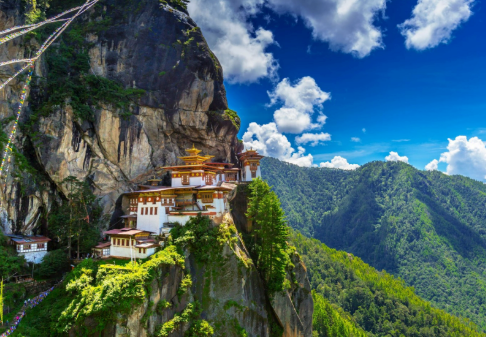
It is one of the most famous of Bhutan's monasteries, perched on the side of a cliff 900m above the Paro Valley floor. It is said that Guru Rinpoche arrived here on the back of a tigress and meditated at this monastery and hence it is called "Tiger's Nest". This site has been recognized as a most sacred place and was visited by Shabdrung Ngawang Namgyal in 1646 and is now visited by all Bhutanese at least once in their lifetime. On 19 April 1998, a fire severely damaged the main structure of the building but now this Bhutanese jewel has been restored to its original splendour.
2. Ta Dzong
One time watch tower was built to safeguard Rinpung Dzong during the inter-valley wars of the 17th century, Ta Dzong was constructed in 1649. And since 1967 it is serving as the National Museum of the country. It holds a fascinating collection of art, relics, religious thangkha paintings and Bhutan's exquisite postage stamps. The museum's circular shape augments its varied collection displayed over several floors.
3. Drukgyel Dzong
This Dzong, with a delightful village nestling at its foot, was built in 1646 by Shabdrung Ngawang Namgyal to commemorate his victory over the Tibetan invaders. Historically and strategically this Dzong withstood all its glory and was featured in 1914 vide National Geographic magazine. The glory of Drukgyel Dzong remained even when it was destroyed by fire in 1951. On a clear day, one can see the commanding view of Mount. Chomolhari from the village, below the Dzong.
4. Kyichu Lhakhang
It is one of the oldest and most sacred shrines of the Kingdom dating back to 7th century (the other is Jambey Lhakahng in Bumthang). The Lhakhang complex is composed of two temples. The first temple was built by Tibetan King, Songtsen Gampo in the 7th century and in 1968, H.M. Ashi Kesang, the Queen Mother of Bhutan, built the second temple in the original pattern.
5. Ka Ja Throm, Paro
Located beside the Ugyen Pelri Palace grounds, Ka Ja Throm Market in Paro is a vibrant hub of local commerce and culture in Bhutan. Nestled in the middle of picturesque town, this bustling market space offers a rich tapestry of traditional Bhutanese life, where visitors can immerse themselves in the sights, sounds, and flavors of the region. It’s a delightful community space where vendors can showcase and sell their produce in a colourful community space. Local vendors, with their warm hospitality, provide a glimpse into Bhutan's heritage and daily life, making Ka Ja Throm not just a place to shop, but a cultural experience that highlights the country’s emphasis on community and tradition.